
Even today, school furniture is still purchased in the same way as it was twenty years ago: from a catalogue, based on price, or because it looks good in the school’s promotional photos. But hardly anyone asks what happens afterwards, when that piece of furniture spends six hours a day in contact with a child’s body and brain.
An uncomfortable classroom triggers stress. Furniture that isn’t suited to a child’s size creates a dependence on adults. A space lacking variety allows for only one way of learning. These are the five mistakes we see time and time again, and how to avoid them.
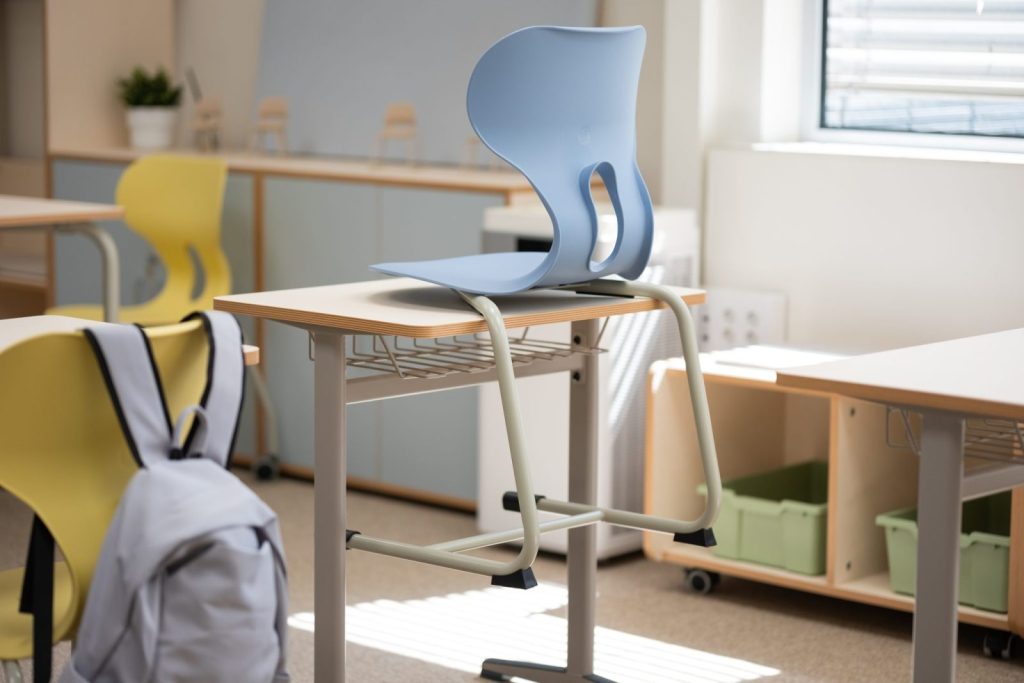
Error 1:
Prioritising aesthetics over functionality
A chair or a table can be very aesthetically pleasing and yet still not work. School furniture is not decoration but a teaching tool. The key lies in reversing the order of the questions: rather than starting with ‘how does it look in the classroom?’, we must first ask ‘does it promote good posture, movement and concentration?’.
Only when an option provides a good answer to that question does it make sense to assess which one fits in best aesthetically with the classroom.
Error 2:
Failing to take into account the size of a child’s body
A four-year-old’s body is not the same as that of a ten-year-old, and yet many schools purchase one-size-fits-all furniture or fail to take age-appropriate furniture sizes into account. When a table or chair is not scaled to suit each age group, the child loses their independence. They struggle to sit down and move about, and require constant help from an adult.
That is why it is advisable to consult the height and age charts first before choosing a model. If children of different sizes are in the same classroom, it is preferable to combine several sizes rather than sticking to just one. Choosing the right size for each stage of development is what enables the child to gain independence within the classroom.
Error 3:
Uniformity and lack of flexibility
Classrooms with rows of identical desks, all facing the blackboard. This model assumes that all children learn in the same way throughout the school day, which is not the case. The alternative is to design the classroom in zones, rather than rows. To achieve this, it is best to combine modular, lightweight furniture that is easy to move with alternatives to traditional desks and chairs: cushions, high tables or work surfaces on the floor.
A flexible classroom — with areas for working standing up, on the floor, in groups or individually — is better suited to different ways of learning and maintaining concentration. Uniformity may be convenient to source, but it impoverishes the educational experience.
Error 4:
Buy from the catalogue, not based on actual use
Choosing furniture solely on the basis of a catalogue or a PDF of product specifications is a common mistake. Without assessing the classroom or understanding how that particular group of children moves around, it is easy to end up with a cupboard that gets in the way or a table that nobody uses as intended.
Furniture must be tailored to the school’s actual needs: how many pupils there are, their ages, the activities they undertake and how much space they have available. This initial assessment should form the starting point for any purchase of school furniture. Without it, any choice is a gamble, with no way of knowing whether it will actually work in the classroom.
Error 5:
Shopping based on price and ignoring safety
The lowest price is almost never the cheapest option in the long run. A piece of furniture without rounded edges, made from flimsy materials or with poor fixings is a risk that you’ll end up paying for sooner or later.
It’s always worth checking the certifications, materials and finishes before comparing prices, and calculating the true cost by taking into account the furniture’s lifespan, not just the initial outlay. Safety isn’t an extra: it’s the first criterion any piece of furniture should meet before entering a classroom.
How we can help you at Mirplay School
Choosing the right school furniture isn’t just about picking the right items from a catalogue, but about having a clear understanding of each school’s actual needs: age groups, spaces, routines and budget. At Mirplay School, we support you through this process from start to finish, ensuring that your investment results in safer classrooms that are tailored to how pupils learn.
This support goes beyond simply choosing the furniture. We help you plan the layout of the space and define the furniture proposal. We also create 3D visualisations so you can see the result before making a decision. We provide advice on interior design and, where necessary, on preliminary architectural designs to adapt the space for educational use. The result is spaces that are more flexible, better organised and tailored to the way pupils learn.
Do you need help purchasing furniture for your school?

