
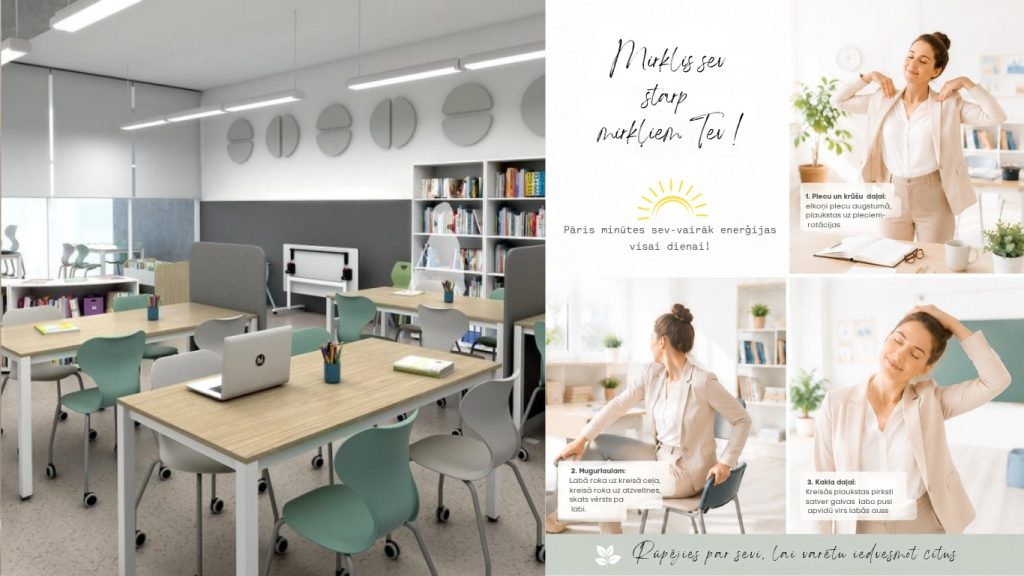
STEAM classrooms are designed for learning by doing and reflect a new way of understanding educational spaces. They are environments where science, technology, engineering, art and mathematics are explored in a practical and multidisciplinary way. School furniture therefore plays a key role: it must encourage creativity, experimentation, concentration and teamwork.
The STEAM approach involves spaces designed with different types of activity in mind. Researching, designing, building, sharing ideas, working with technology or presenting a project all require flexible, dynamic environments capable of adapting to every stage of the learning process.
This vision ties in directly with the concept of the classroom of the future: versatile, technology-driven and learner-centred spaces, capable of evolving alongside educational methodologies. In this context, the environment itself plays an educational role. The arrangement of the furniture and the flexibility of the space have a direct influence on pupils’ motivation, concentration and participation.
Essential school furniture for a STEAM classroom
A STEAM classroom should be equipped with versatile, durable and easily rearrangeable furniture, capable of supporting the different stages of learning: investigating, creating, collaborating, presenting or working individually.
Modular tables, chairs on castors, stools, storage cupboards, mobile whiteboards and tiered seating are some of the key elements for creating a dynamic and functional environment. Each of these helps to structure the space, promotes pupils’ independence and allows the classroom to be adapted to different activities without compromising on tidiness or comfort.
How to organise a STEAM space to encourage creativity and experimentation
A STEAM classroom is organised by function. Each area should serve a specific purpose within the learning process: researching, designing, collaborating, concentrating, working with technology, reading or presenting ideas.
Research and Design Area
The research and design area should be an active, comfortable space, well-suited to working on ideas, materials and prototypes. For this area, a good combination might be the Lia Stool paired with the Space Plus school table.
Stools allow for a more dynamic posture and facilitate movement, whilst high tables provide a spacious and functional surface for designing, observing, building or working with materials. It is an area designed for experimentation and hands-on learning.

Collaboration and group work Area
Collaborative work is one of the cornerstones of the STEAM approach. To encourage this, the furniture should foster conversation, the exchange of ideas and the participation of all pupils.
The Octa school desk, arranged in a circle, allows all pupils to see one another and converse easily. Combined with the Lia Castors chair on castors, this area becomes a flexible, dynamic space designed for teamwork.
This layout helps to break away from the traditional classroom structure and facilitates more open, participatory and horizontal dynamics.

Concentration Area
Although STEAM learning is based on collaboration, it also requires moments of individual concentration. That is why it is important to set aside a quieter area for reading, reflecting, completing exercises, sketching ideas or making progress on personal tasks.
The Lia Table school chair is a suitable solution for this type of space, as it allows pupils to work individually without the need for major rearrangements. This area brings balance to the classroom and offers pupils a place to concentrate when the activity requires it.

Technology Area
Working with computers, digital devices or technological tools requires a specific, well-organised and comfortable area. Space Design school tables, together with the Lia Basic school chair, enable the creation of a functional area for digital activities, information research, programming, design or project documentation.
This space should be accessible and integrated within the classroom, yet sufficiently distinct so that the use of technology does not interfere with other, more practical or collaborative activities.

Reading and quiet Area
A STEAM classroom can also incorporate spaces for reading, reflection and taking a break. These environments help to balance the intensity of practical activities and offer pupils a more secluded place to consult resources, read, chat or rest.
The Kalin school sofa can be combined with Marie school cupboards arranged in a circle to create a more enclosed, cosy and distinct space within the classroom. This layout helps to define the area without completely isolating it. The Pop school stool adds versatility and allows the space to be expanded as and when required.

Presentation Area
Presenting ideas, explaining processes and sharing results are all part of STEAM learning. That is why the classroom should have an area set aside for presentations, discussions or group sharing sessions.
The Kido school stand creates a comfortable and functional presentation space. As well as serving as a podium, it incorporates storage space, making it a particularly useful solution for classrooms where every item must fulfil more than one function.
This area enhances communication, boosts pupils’ confidence when presenting, and fosters the ability to share what they have learnt with the group.

The ideal school furniture for a STEAM classroom should be flexible, durable, comfortable and capable of adapting to different ways of learning. Each area of the classroom serves a specific purpose within the educational process, from research and group work to concentration, technology, reading or presenting ideas.
As such, furniture ceases to be a secondary element and becomes a teaching tool capable of transforming the classroom into a versatile, inspiring space that is equipped to meet the challenges of today’s education.


